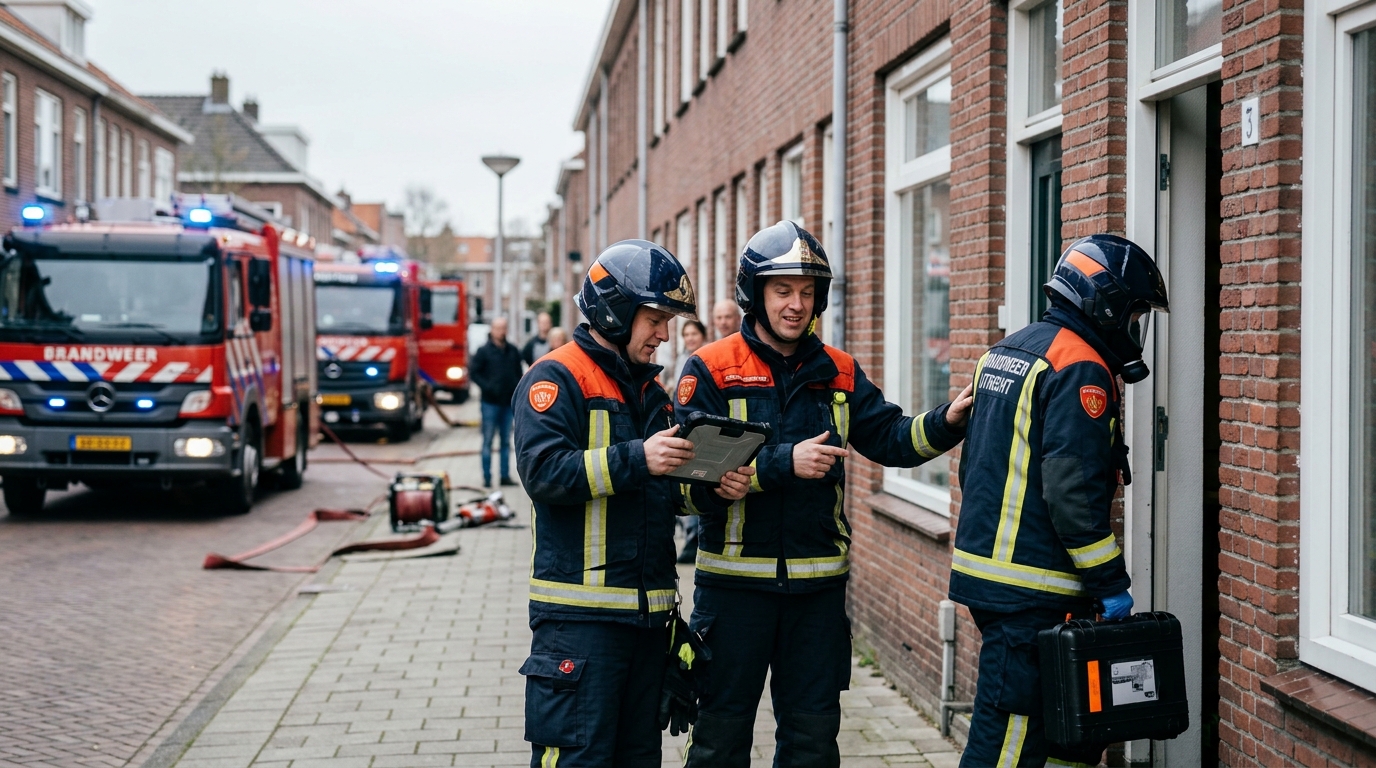
UTRECHT, Netherlands — A full-scale emergency response unit, including two heavy rescue pumpers and an aerial ladder platform, was dispatched to a suburban townhome on Tuesday morning after municipal predictive-safety sensors detected a statistically significant accumulation of minor household imbalances.
The occupant, 42-year-old risk analyst Gerhardt Visser, was preparing breakfast when his smart-home telemetry flagged a sequence of low-level operational anomalies. According to municipal logs, Visser dropped a butter knife onto the linoleum, left a cabinet door open at a 35-degree angle, and exhibited a slightly erratic gait while carrying a ceramic mug of medium-roast coffee.
Under Utrecht’s municipal Predictive Safety Ordinance, these events—while individually harmless—triggered a Level 4 Pre-Emergency Intervention after crossing a critical mathematical threshold.
"When you have three micro-slips within a 240-second window, the probability curve steepens sharply," said Captain Bram van der Meer of the Utrecht Fire and Rescue Service, speaking from behind a cordon of high-visibility tape erected in Visser’s hallway. "To do nothing would be mathematically negligent. We are sworn to protect this community, and that means intervening before the laws of probability resolve themselves on Mr. Visser’s wool rug."
Upon arrival, first responders secured the perimeter and entered the residence with specialized stabilizing equipment. Firefighters deployed a high-viscosity containment foam around the kitchen island to mitigate potential liquid travel, while a hazardous materials team used a hydraulic leveling clamp to safely transfer the mug from Visser’s hand to a rubberized counter surface.
Visser, who specializes in maritime insurance liabilities, remained cooperative throughout the two-hour stabilization process.
"I understand the department’s position," Visser said, speaking from a designated low-kinetic recovery chair where he was instructed to remain motionless until his personal variance score returned to baseline. "If I had taken that fourth step toward the dining table with the mug filled to 94% capacity, the likelihood of a high-temperature liquid-to-fabric event crossed the 0.05 alpha level. It’s simple regression to the mean. I’m just glad they had the heavy rescue pumper available."
The incident has renewed debate over the city’s proactive resource allocation. Critics argue that dispatching sixteen active-duty firefighters to prevent a potential coffee spill is an inefficient use of public funds. However, local administrators point to a 14% drop in minor kitchen cleanup times since the predictive dispatch system was implemented last autumn.
"We operate on a zero-variance mandate," said Dr. Anika de Jong, Director of the Utrecht Municipal Data Registry. "Waiting for a spill to occur before sending help is a 20th-century paradigm. By deploying resources at the point of statistical inevitability, we save the homeowner the emotional and physical toll of a damp sock."
As of Tuesday afternoon, Visser’s kitchen had been declared fully stabilized. Fire crews departed after adjusting his cabinet hinges and issuing a temporary restriction on his use of glassware.