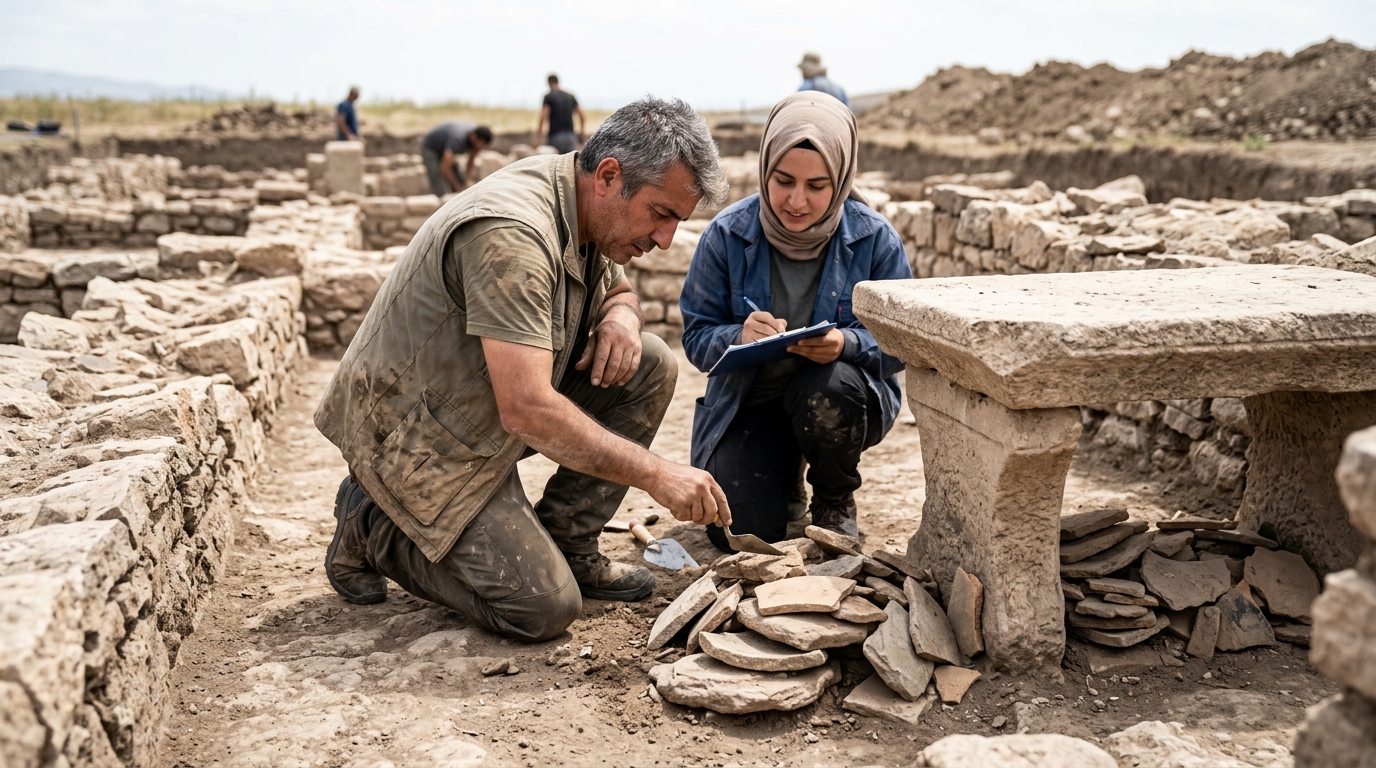
KONYA, TURKEY — Archaeologists excavating a Bronze Age settlement in Turkey’s central Anatolian plateau have uncovered the remains of a highly organized, prosperous city-state whose entire civic, religious, and economic life was dedicated to preventing household furniture from wobbling.
The site, known formally as Tell al-Rihan, dates back to approximately 1800 BCE. Lead researcher Dr. Evelyn Vance of the Institute for Mediterranean Archaeology noted that while the city possessed advanced metallurgy and sophisticated urban planning, nearly 40 percent of the recovered artifact assemblage consists of small, wedge-shaped clay discs called "tsillu."
"We initially assumed these objects were votive offerings to a harvest deity, or perhaps a form of early currency," Vance said. "But as we mapped the domestic quarters, we found them wedged exclusively beneath the legs of three-legged stools, dining platters, and large grain storage chests. They weren't worshiping the gods; they were leveling their coffee tables."
Further translation of cuneiform tablets found in the city’s central administrative complex suggests a highly stratified bureaucracy managed by a state-sponsored guild known as the "Order of the Level Plinth." These civil servants were tasked with measuring the slope of residential stone floors and distributing standardized clay shims of varying thicknesses—ranging from three millimeters to a robust two centimeters—to citizens experiencing domestic tilt.
Social status in Tell al-Rihan appears to have been directly linked to how perfectly parallel one's dining surfaces were to the horizon. High-status tombs contained elaborate slate levels and silver-plated shims, while poorer quarters relied on crudely folded scraps of animal hide or double-layered papyrus.
"What is striking is the sheer expenditure of intellectual labor," said Dr. Aris Thorne, a cultural anthropologist at the University of Chicago who co-authored the study. "Instead of inventing adjustable screw-in legs or simply flattening their stone floors, this society chose to manufacture millions of highly precise, single-use clay wedges to solve the exact same minor irritation every single day. It was a multi-generational commitment to temporary fixes."
The obsession eventually led to the civilization’s collapse, according to soil core samples and architectural analysis. During the late Bronze Age, the city’s grand temple began to sink due to shifting groundwater. Rather than reinforcing the structural foundation, priests spent three decades baking and inserting increasingly massive clay wedges beneath the temple’s eastern columns.
"The temple eventually tipped over during a minor tremor in 1740 BCE," Vance said, gesturing to a collapsed trench of shattered limestone and thousands of crushed clay wedges. "They were only three millimeters away from a perfect balance."