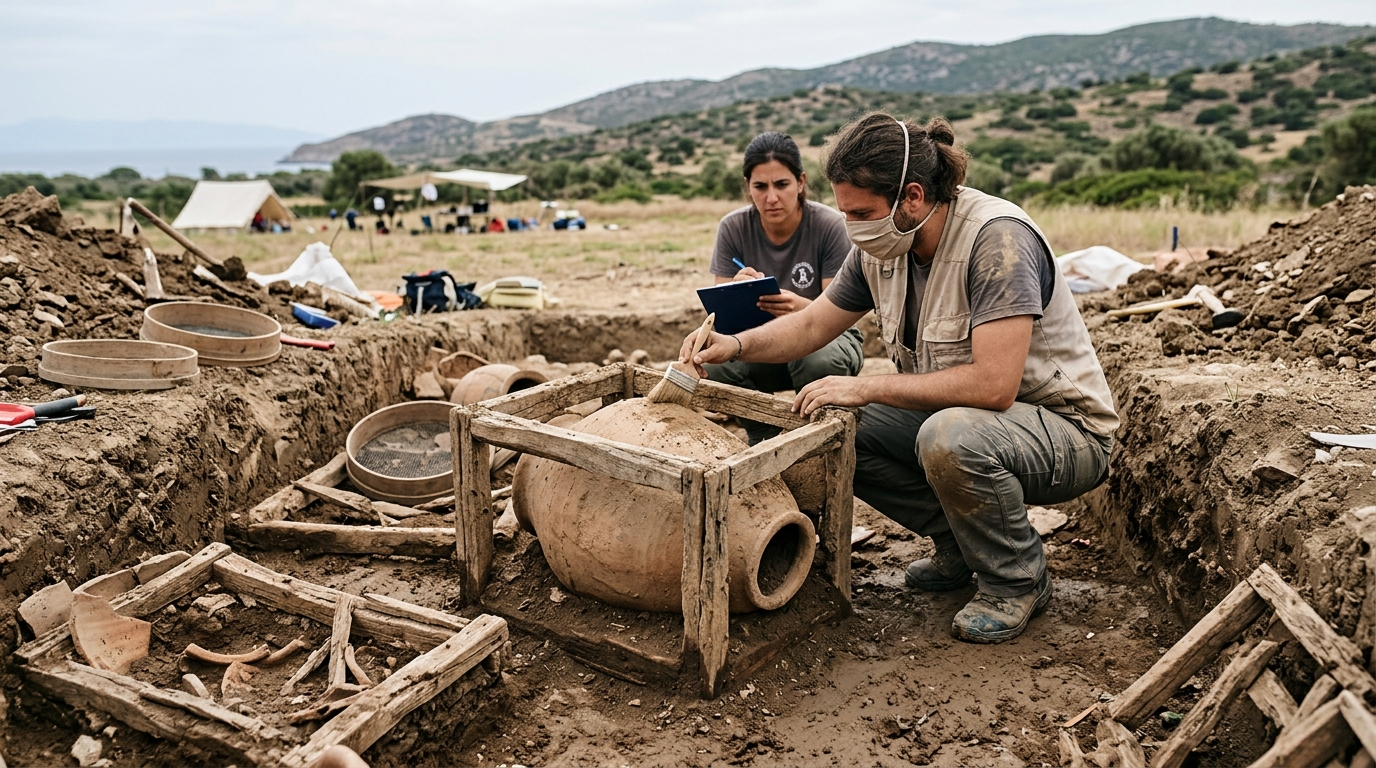
ATHENS — Archaeologists excavating a Late Bronze Age settlement on the Aegean island of Kythira have unearthed the remnants of a highly organized civilization whose religious, domestic, and architectural lives were entirely dictated by the preservation of empty shipping containers.
The site, known to researchers as Askra-on-the-Hill, dates to approximately 1300 BCE. According to a report published Tuesday in the Journal of Aegean Archaeology, excavations of over 200 domestic dwellings revealed that up to 40 percent of available residential floor space was dedicated to the systematic storage of empty, nested clay vessels and wooden crates that served no active functional purpose.
"We initially believed these chambers were grain silos or communal treasury vaults," said Dr. Helena Vance, lead archaeologist at the Aegean Institute of Antiquities. "However, translation of the Linear B tablets found on-site reveals these rooms were designated as 'The Chambers of Just in Case.' The citizens of Askra spent generations hoarding the exact packaging in which their household goods arrived, under the collective cultural belief that they might one day need to send them back."
The tablets paint a picture of a society deeply paralyzed by the logistical anxiety of the potential return. One tablet, translated by epigraphists last month, contains a stern warning from a household patriarch to his sons, advising them never to discard the straw-lined wooden crate of a newly acquired olive press, "lest the merchants of Tyre refuse to honor the exchange of the broken spindle."
Archaeological evidence suggests this preoccupation eventually escalated into a structural crisis. By the late 12th century BCE, residential architecture in Askra had evolved to accommodate this hoarding. Homes were constructed with massive, low-ceilinged crawlspaces—referred to in texts as kryptē pyxis—designed specifically to hold flattened woven baskets and dried gourds that had once contained imported spices.
"It was a highly sophisticated, yet completely self-inflicted spatial bottleneck," said Dr. Marcus Thorne, a cultural anthropologist at the University of Edinburgh who co-authored the study. "They weren't using these containers. In fact, many of the baskets we recovered still have their original clay security seals intact. The Askrians lived in cramped, single-room quarters so that their empty amphorae could enjoy spacious, climate-controlled alcoves."
The obsession also permeated Askrian theology. Excavations of the town's central temple revealed a pantheon of minor deities associated with transit, including Krates, the protector of original corners, and Epistrophe, the goddess of the seamless return journey. Votive offerings found at the temple altar did not consist of gold or grain, but rather pristine, unused packing twine and protective river reeds.
Researchers believe the civilization’s sudden collapse around 1150 BCE, long attributed by historians to invasions by the mysterious Sea Peoples, may have actually been internal.
"When you dedicate nearly half of your city’s physical footprint to storing the boxes your lifestyle came in, you eventually run out of room to live," Vance said. "The final layers of the site show a people literally pushed out of their own homes by the theoretical weight of their own future returns."