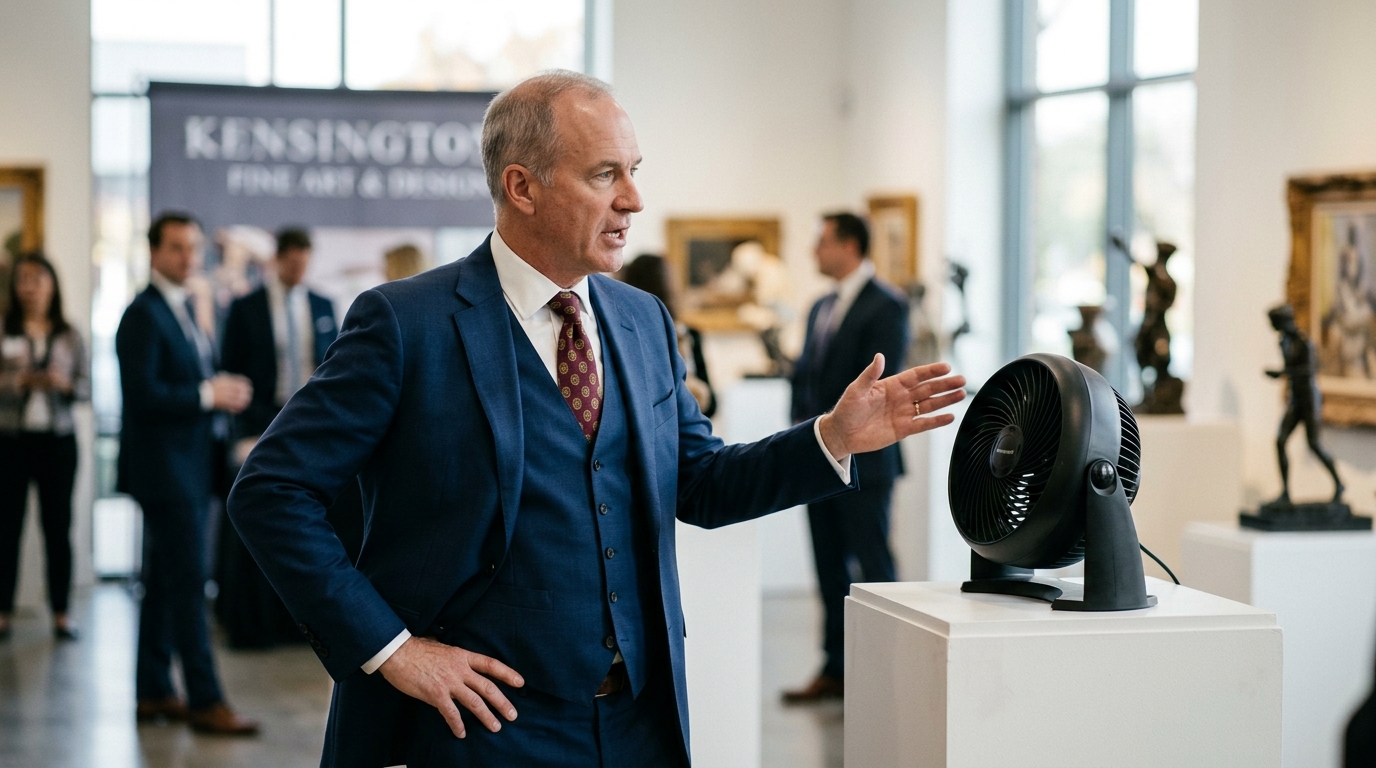
LONDON — Elite auction house Kensington’s confirmed Friday that a standard Honeywell HT-900 TurboForce desk fan, mistakenly cataloged as a rare work of German minimalism, has successfully sold for £1.85 million ($2.42 million) to a Swiss private asset registry.
The black, three-speed plastic fan, which had been cooling a routing switch in the auction house’s basement IT closet since 2018, was accidentally assigned the lot number intended for Atemstille (2014), a highly anticipated sculpture by conceptual artist Hans-Dieter Beck. The actual artwork, a 400-pound slab of solid sandblasted limestone, remained undisturbed in a shipping crate in the loading dock while bidding on the fan escalated over nine minutes.
Despite the clerical mix-up, Kensington’s officials announced they would not void the sale, citing a strict "as-is, where-is" policy for all cataloged lots.
"While a minor data-entry variance occurred during the inventory reconciliation process, we believe the final hammer price reflects the true market appetite for the object’s conceptual rigor," said Julian Vance-Dover, Senior Vice President of Post-War and Contemporary Art at Kensington’s. "The Honeywell piece possesses a raw, utilitarian presence that clearly resonated with the floor. The dialogue between the high-impact polystyrene housing and the three-speed manual dial represents a stark, almost violent interrogation of late-industrial air circulation."
The buyer, Geneva-based wealth management firm Aurelius Group, also rejected the notion that they had purchased a routine office appliance. In a statement issued Friday, the firm defended the acquisition as a cornerstone of their contemporary portfolio, noting that they have already appraised the fan at $3.1 million for insurance purposes.
"We did not buy a fan; we bought the institutional consensus of a fan," said Aurelius Group’s managing partner, Marcus Keller. "When you look at the slight accumulation of gray carbon dust on the three plastic blades, you are looking at a physical archive of Kensington’s operational history. It is a profound monument to administrative labor. We have already instructed our couriers to handle the power cord with white cotton gloves."
Legal experts noted that reversing the sale could have triggered complex tax liabilities for both parties. Under current international art-import laws, classifying the object as an industrial appliance would subject it to standard VAT, whereas cataloging it as a unique cultural asset allows it to enter a tax-free freeport storage facility in Luxembourg.
Art historians have quickly adapted to the sale. Dr. Evelyn Thorne, a professor of critical theory at the Courtauld Institute of Art, remarked that the mistake itself has become part of the object’s provenance.
"The Honeywell HT-900 has long been an overlooked text of the anthropocene," Thorne said. "By operating at 110 volts within an auction house setting, it challenges the spectator to ask: who is cooling whom? The fact that it was purchased for the price of a luxury townhouse only elevates its critique of global capital."
At press time, Kensington’s technicians were reportedly attempting to locate the original Honeywell cardboard box and instruction manual to present to the buyer as a deluxe two-volume monograph.