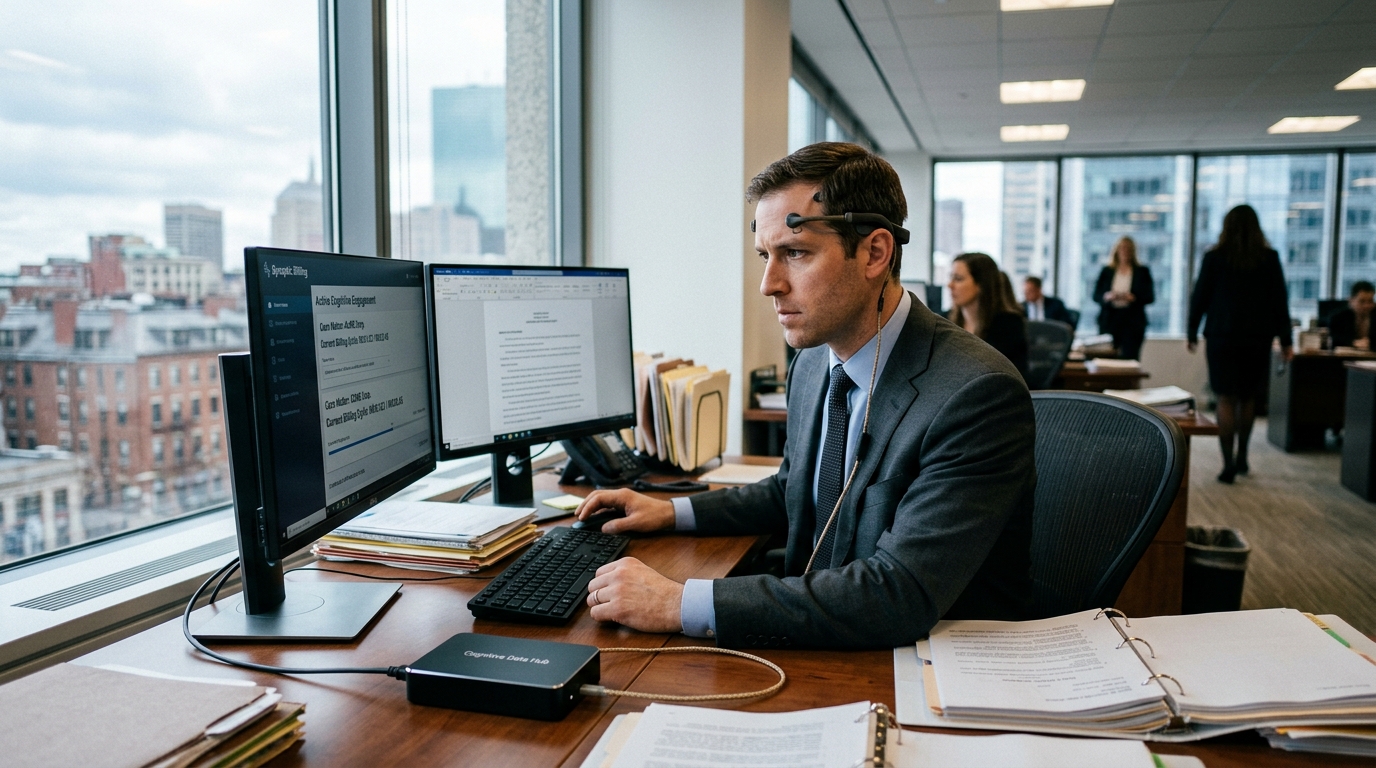
BOSTON — National law firm Crane, Sterling & Vanderhoof has announced the rollout of "Synaptic Billing," a new billing framework that allows attorneys to invoice corporate clients for the exact minutes spent thinking about their cases outside of traditional working hours.
The system, which went live across the firm’s East Coast offices on Monday, aims to capture what management describes as "leakage"—the unmonitored mental labor that occurs during commutes, family dinners, and periods of light insomnia. Under the new guidelines, attorneys use a proprietary mobile application to log "cognitive sessions" in increments as small as forty-five seconds.
"The billable hour has historically been limited by the physical presence of a lawyer at a desk," said Arthur Vance, managing partner at the firm. "But the legal mind does not shut down at 6:00 p.m. If a senior associate solves a complex jurisdictional conflict while staring at a display of heirloom tomatoes, that is billable intellectual property. To give that away for free is a disservice to our partners."
To ensure accuracy and prevent billing disputes, the firm’s proprietary app, MindTrack, requires attorneys to categorize their thoughts immediately upon "returning to a baseline state." The billing codes are highly specific, ranging from Code 881-A ("Targeted Epiphany during Aerobic Exercise") to Code 881-D ("Subconscious Processing during REM Sleep").
The firm’s clients have reacted with a mix of resignation and administrative exhaustion. Marcus Thorne, general counsel for global shipping conglomerate Apex Marine, noted that his company's latest invoice included an extra $4,200 for "ambient contemplation" logged by a lead defense attorney over a single weekend.
"We questioned a line item for '18 minutes of associative reasoning' that occurred during a child’s birthday party," Thorne said. "But the attorney was able to produce a timestamped voice memo demonstrating how a balloon animal reminded her of our maritime liability clause. The logic was sound, so we paid it."
The American Bar Association has convened a task force to examine the ethical implications of the practice, specifically regarding the quality of the thoughts being billed. Some ethics experts worry that clients could be charged full partner rates for "low-efficiency cognitive states," such as thoughts processed while moderately dehydrated or mildly distracted by traffic.
Crane, Sterling & Vanderhoof has dismissed these concerns, pointing to their new "Thought Audit" division, which employs three full-time analytical specialists to verify that billed thoughts met the firm's strict standards of legal utility.
Meanwhile, the firm’s junior associates have expressed quiet concern over the pressure to maintain constant mental billability.
"I used to look forward to my Sunday morning run as a way to clear my head," said one third-year associate, speaking on the condition of anonymity to protect his career. "Now, if I run for five miles and don't come back with at least three billable defense strategies, my mentor asks if I'm experiencing a cognitive slump. I’ve started keeping a deposition transcript on my nightstand just in case I wake up in a panic."