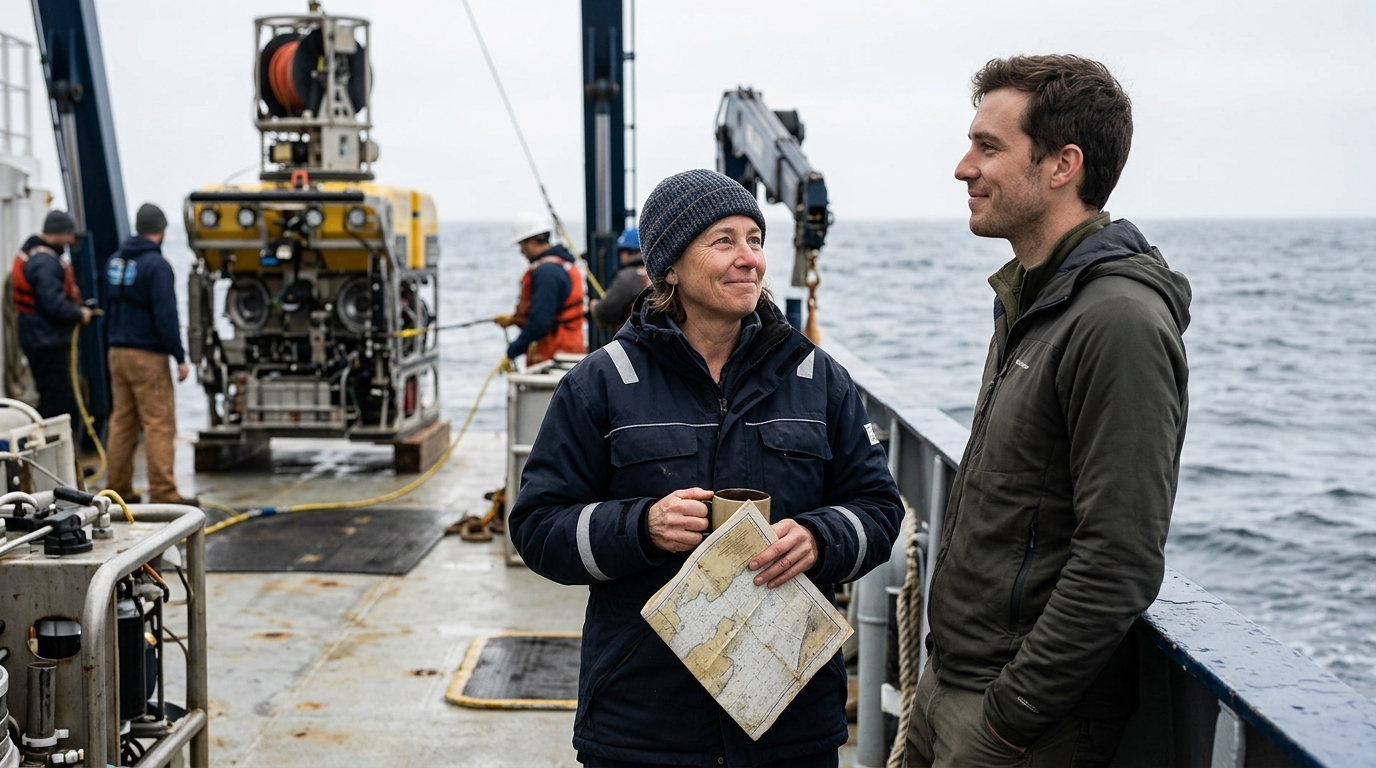
ST. JOHN'S, Newfoundland — The Laurentian Abyssal Research Coalition secured a $42.5 million funding extension on Friday, following an 18-month deep-sea expedition that successfully returned with zero biological, geological, or archaeological findings.
The voyage of the research vessel Aegir, which mapped a 400-square-mile sector of the Atlantic seabed, yielded 14,000 hours of high-definition video footage consisting entirely of featureless, pitch-black water. According to the coalition's final report, the mission achieved "total baseline verification," confirming that the targeted zone remains completely devoid of interest.
"To go down into the absolute dark and find nothing is a triumph of methodological consistency," said Dr. Arthur Vance, the expedition's lead scientist. "A less disciplined team might have drifted toward a hydrothermal vent or a shipwreck just to have something to show the public. We maintained our grid. We documented the void with millimeter-level precision."
The Global Maritime Science Alliance, which administered the grant, praised the expedition as a model of fiscal and scientific predictability. In its evaluation, the Alliance noted that by avoiding the complications of discovering new species—which require costly cataloging, taxonomy disputes, and preservation resources—the Aegir team completed its voyage 12% under budget.
"The scientific community is often obsessed with 'findings,' which is a highly biased way of looking at the ocean," said Dr. Elena Rostova, chairperson of the funding committee. "By proving that there is absolutely nothing of note in Sector 9, the Laurentian team has saved future researchers from the burden of ever going there again. That is the kind of efficiency we are proud to fund."
The renewed grant will fund "Phase II: The Void Extended," a three-year project to lower the same cameras five hundred meters deeper to determine if the lack of activity continues.