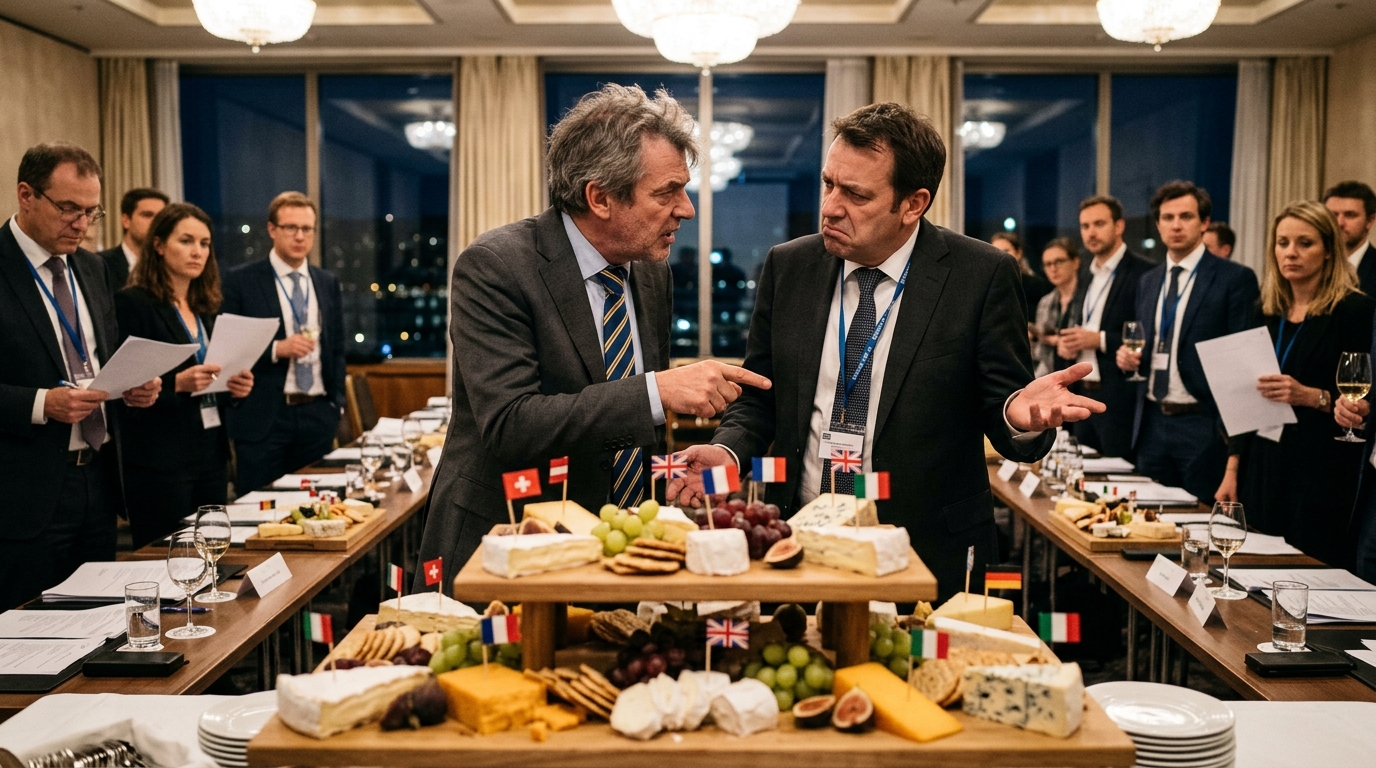
ZURICH — A landmark trade summit aimed at stabilizing global maritime supply chains collapsed early Thursday morning after negotiators from 14 nations failed to resolve a bitter, 36-hour dispute regarding the geographical distribution of dairy products on the VIP luncheon’s cheese boards.
The collapse of the Zurich Maritime Accord, which had been four years in the making, has left an estimated $400 billion in tariff reductions in limbo. Diplomats reportedly reached a total impasse not over shipping lane quotas or carbon taxation, but over the physical layout of a three-tiered charcuterie display prepared by a local Swiss catering subcontractor.
According to sources inside the Alpine Ballroom of the Grand Hotel Bellevue, the crisis began on Tuesday afternoon during a working session on deep-sea freight access. Laurent Dubois, the lead trade attaché for the French delegation, formally objected to a Spanish Manchego occupying the central apex of the top tier, which positioned it physically superior to a French Brie de Meaux.
"To place a hard sheep's milk cheese from La Mancha physically elevated above a soft cow's milk cheese from Seine-et-Marne is not a culinary choice; it is an un-ratified statement on European agricultural hierarchy," Dubois said in a press conference following the walkout. "We requested immediate geographic parity. We were offered a compromise of equal-height slate tiles, but by that point, the spirit of mutual respect had been compromised."
The dispute quickly escalated as other delegations began analyzing the buffet table for national slights. Spanish Secretary of Commerce Elena Vargas-Cruz defended the Manchego's prominent placement, citing Spain’s recent 4.2 percent growth in agricultural exports. Vargas-Cruz reportedly told the plenary session that "the cheese board must reflect contemporary macroeconomic realities, not 18th-century Westphalian borders."
By Wednesday morning, the actual maritime treaty had been shelved entirely. Working groups were hastily reassigned to draft a temporary memorandum of understanding regarding the buffet's structural layout. However, those emergency talks broke down when the Brazilian delegation noticed their regional guava paste had been classified as a "spreadable condiment" and placed next to common German mustards, rather than being designated as an "artisanal preserve."
"This is a textbook failure of modern multilateralism," said Dr. Arthur Pendelton, a professor of diplomatic protocol at the Geneva School of Economics. "When you bring together nations with deeply entrenched agricultural identities, you cannot delegate the catering to a third-party subcontractor who operates on a purely aesthetic framework. You cannot place a Prosciutto di Parma adjacent to a French cornichon without expecting a debate on the legacy of the Common Agricultural Policy."
An overnight attempt by Swiss mediators to defuse the situation by replacing the cheese boards with a "neutral starch basket" of water crackers also failed when Italian delegates objected to the inclusion of British water biscuits, citing post-Brexit trade restrictions.
At 4:15 a.m. on Thursday, the Swiss Secretariat declared a formal impasse and officially dissolved the summit. Outside the conference hall, hotel staff were observed loading several dozen untouched wheels of artisanal cheese into a municipal disposal vehicle, while a cleaning crew swept up unused, custom-engraved cocktail napkins representing a trade partnership that no longer exists.