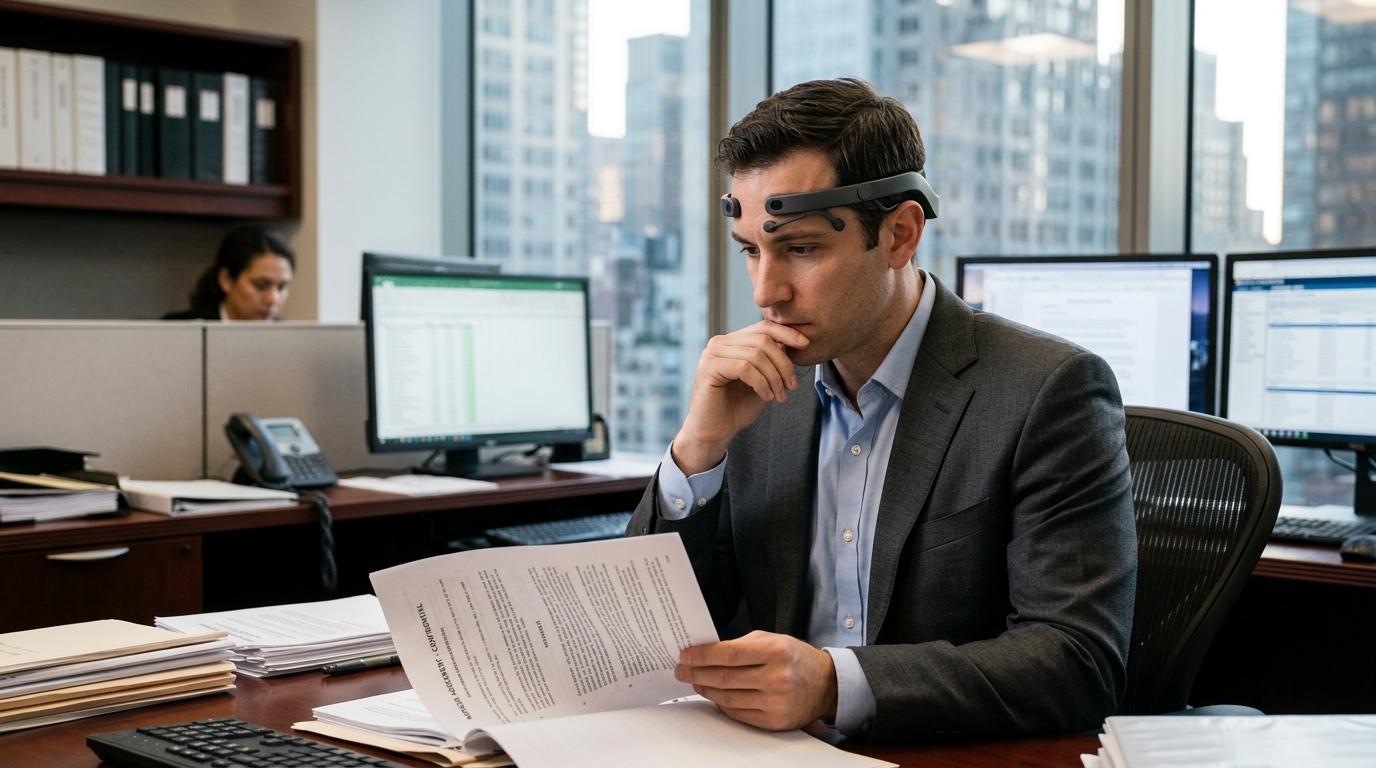
NEW YORK — Prominent corporate law firm Sterling, Vance & Harlow LLP announced Thursday the rollout of a proprietary billing category, "Passive Cognition," allowing attorneys to bill clients for time spent thinking about their cases while engaged in non-work activities.
The system, which utilizes lightweight electroencephalogram (EEG) headbands manufactured by neuro-tech startup Cerebra, tracks neural activity in the prefrontal cortex. When the algorithm detects brainwave patterns consistent with deep analytical problem-solving, it automatically logs billable increments of 0.1 hours to the corresponding client account, regardless of whether the attorney is at their desk, purchasing groceries, or attending a child's piano recital.
Under the new "Billable Mind" initiative, the firm has established four distinct cognitive tiers. "Tier 1: Focused Introspection" covers active daydreaming during commutes, while "Tier 4: Subconscious Synthesis" captures solutions generated during REM sleep.
"For decades, the legal industry has operated under the archaic assumption that legal work only occurs when fingers are touching a keyboard," said senior managing partner Arthur Vance. "But some of our associates' most brilliant litigation strategies occur while they are staring blankly at a wall in a dry cleaner. To not bill for that intellectual labor is a disservice to our partners."
Clients have expressed mixed reactions to the new invoicing structure. Marcus Brody, chief financial officer of global logistics firm Vanguard Transit, recently questioned a line item on his July invoice charging $1,800 for "unsolicited shower-based breakthrough analysis" regarding a shipping dispute.
"The breakthrough was genuine—they realized we could exploit a loophole in maritime law," Brody said. "But it is difficult to audit an invoice where the location of the work performed is officially listed as 'the deep end of a suburban YMCA pool.'"
To maintain billing accuracy, Sterling, Vance & Harlow associates are required to wear the Cerebra bands for at least 22 hours a day. The firm has dismissed privacy concerns, noting that thoughts unrelated to client matters—such as personal anxieties, grocery lists, or marital tension—are automatically filtered out by the software and categorized as "non-billable administrative noise."
However, the pressure to maintain cognitive output has already begun to affect the firm's junior associates. Several first-year lawyers, speaking on the condition of anonymity, reported using targeted sensory deprivation and high-caffeine regimens to force their brains into prolonged states of high-value litigation analysis.
"If I go to sleep without dreaming about antitrust regulation, I fall behind on my billables," one associate said. "Last night I dreamt about a merger for six hours, which was great for my metrics, but I woke up exhausted and still had to log eight hours of physical typing."