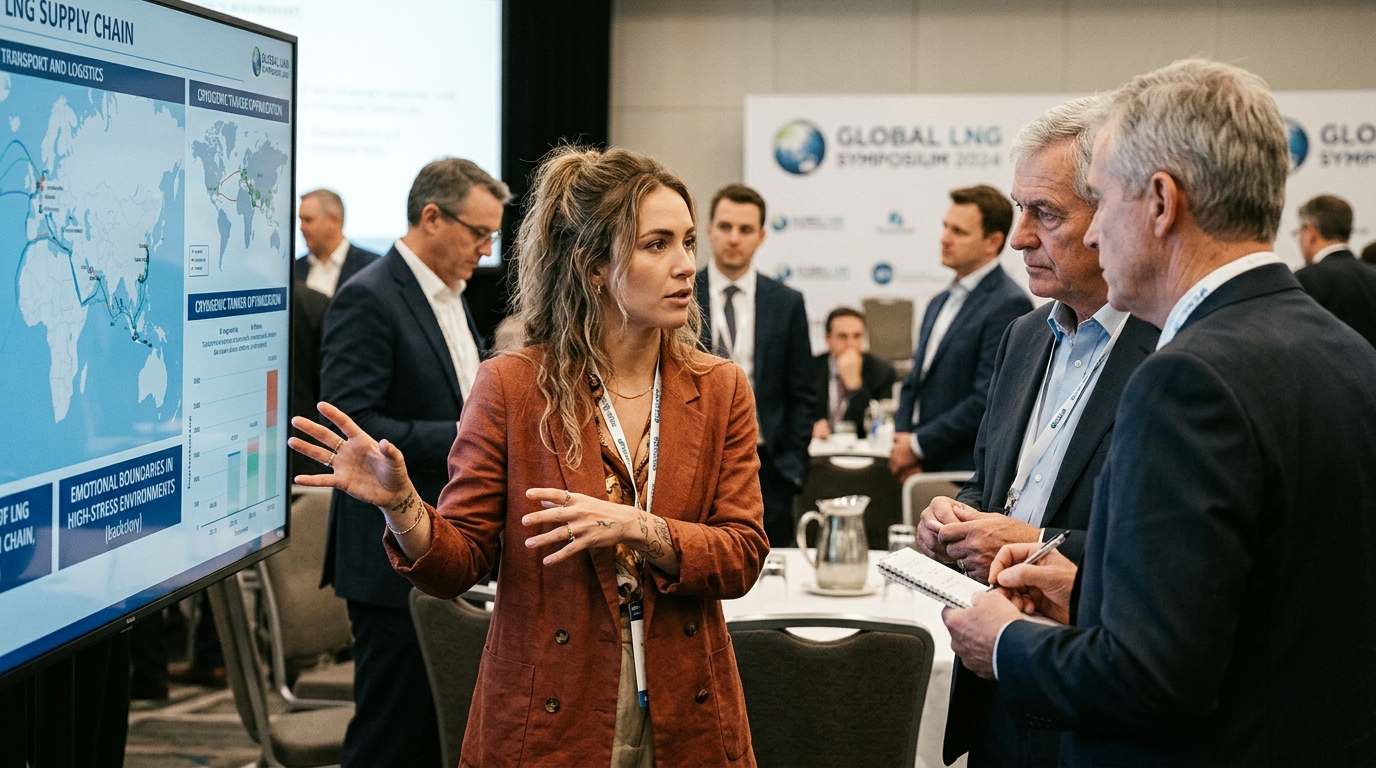
HOUSTON — When lifestyle content creator Chloe Vance uploaded a short video to her social media channels in late April, she intended to offer her 410,000 followers a simple metaphor for emotional self-regulation. Instead, she initiated a paradigm shift in the international transport of liquefied natural gas.
Today, the 26-year-old wellness influencer is the highest-paid external advisor to three of the world's largest midstream energy corporations. She is currently preparing to deliver the closing keynote address at tomorrow’s Gulf Coast Cryogenics Symposium, where she will speak to over 1,500 industrial engineers on the mechanics of thermodynamic equilibrium.
Her journey into the upper echelons of the energy sector began with a fundamental linguistic misunderstanding. While visiting family in Louisiana, Vance overheard her brother-in-law, a pipeline dispatcher, discussing "boil-off gas mitigation"—the critical process of managing pressure inside highly insulated LNG containment tanks when ambient temperatures rise.
Believing the term was a piece of spiritual slang, Vance posted a video in her signature neutral-toned linen loungewear. "If you aren’t practicing BOG mitigation in your daily relationships, you are going to rupture," Vance told her audience while preparing a matcha latte. "When the temperature around you rises, you have to let yourself vent. Don't try to hold the pressure. Just release the vapor. It's okay to flare off."
The video quickly bypassed her usual demographic of yoga instructors and interior designers, finding its way into the automated keyword alerts of energy sector executives. Due to a combination of algorithmic classification and a corporate push for "disruptive, human-centric leadership frameworks," Vance was invited to speak at a regional pipeline safety conference in Galveston last June.
Dr. Aris Thorne, Director of Cryogenic Research at the Texas Institute of Technology, was in the audience. He recalls the presentation as a watershed moment for the industry.
"Her holistic approach to structural thermal acoustics was unorthodox but mathematically undeniable," Dr. Thorne said. "When Ms. Vance spoke about 'the trauma of over-insulation' and how 'closed loops inevitably lead to catastrophic structural failure,' we realized we were over-engineering our Type B independent containment tanks. We were keeping the product too tight. Her advice to 'let the tank breathe its truth' inspired us to recalibrate our pressure-relief valve thresholds by exactly 4.2 percent."
The resulting adjustment across twelve offshore shipping vessels reduced boil-off product loss by an estimated $14 million in the third quarter alone.
Since then, Vance’s consulting firm, BOG Global, has secured long-term advisory contracts with major energy conglomerates. Her daily rate has risen to $15,000, plus travel expenses. Her duties consist primarily of touring deepwater port facilities, walking past towering spherical storage vats, and offering intuitive assessments of their structural energy.
"We had her walk through our Sabine Pass export terminal last month," said Marcus Vance, Vice President of Operations at Gulfstream Midstream, who is of no relation to the influencer. "She pointed at a secondary manifold on a liquefaction train and said, 'This one feels very defensive. It's holding onto things.' We shut down the train for inspection and discovered a microscopic hairline fracture in the weld. Her intuitive grasp of metal fatigue under cryogenic stress is nothing short of supernatural."
Inside the industry, Vance is now widely credited with introducing "mindful thermodynamics" to a sector traditionally dominated by rigid logistical models. Her 20-minute consultation sessions, during which she encourages logistics managers to treat pipeline systems as "sensitive, flowing rivers of cold light," have reportedly reduced unscheduled downtime at three major Gulf Coast facilities.
Despite her success, Vance remains largely unaware of what liquefied natural gas actually is, or how it differs from other fossil fuels. During an afternoon site visit to a shipping terminal on Tuesday, she stood on the pier wearing a high-visibility orange vest over her designer activewear, looking out at a 300-meter-long double-hulled tanker.
"The big ships are just giant water signs," Vance said, adjusting her safety glasses. "They have so much emotional weight, and they're carrying it across these vast, lonely distances. Of course they need to vent. If we don't let them express their pressure, they're going to manifest that stress physically. It's just basic physics, honestly. You have to honor the flow."
Industry analysts expect Vance’s influence to expand. She has recently been approached by the Federal Energy Regulatory Commission to consult on interstate pipeline routing protocols, a process she plans to approach by assessing the "vibrational alignment" of prospective soil samples.
"She doesn't use our jargon, which is why she's so effective," Dr. Thorne added, flipping through a PowerPoint slide featuring Vance’s signature quote on a background of cryogenic piping. "When she tells us to 'stop suffocating our liquids,' we know exactly which valves she means. It’s the most clear-headed engineering advice we’ve had in thirty."