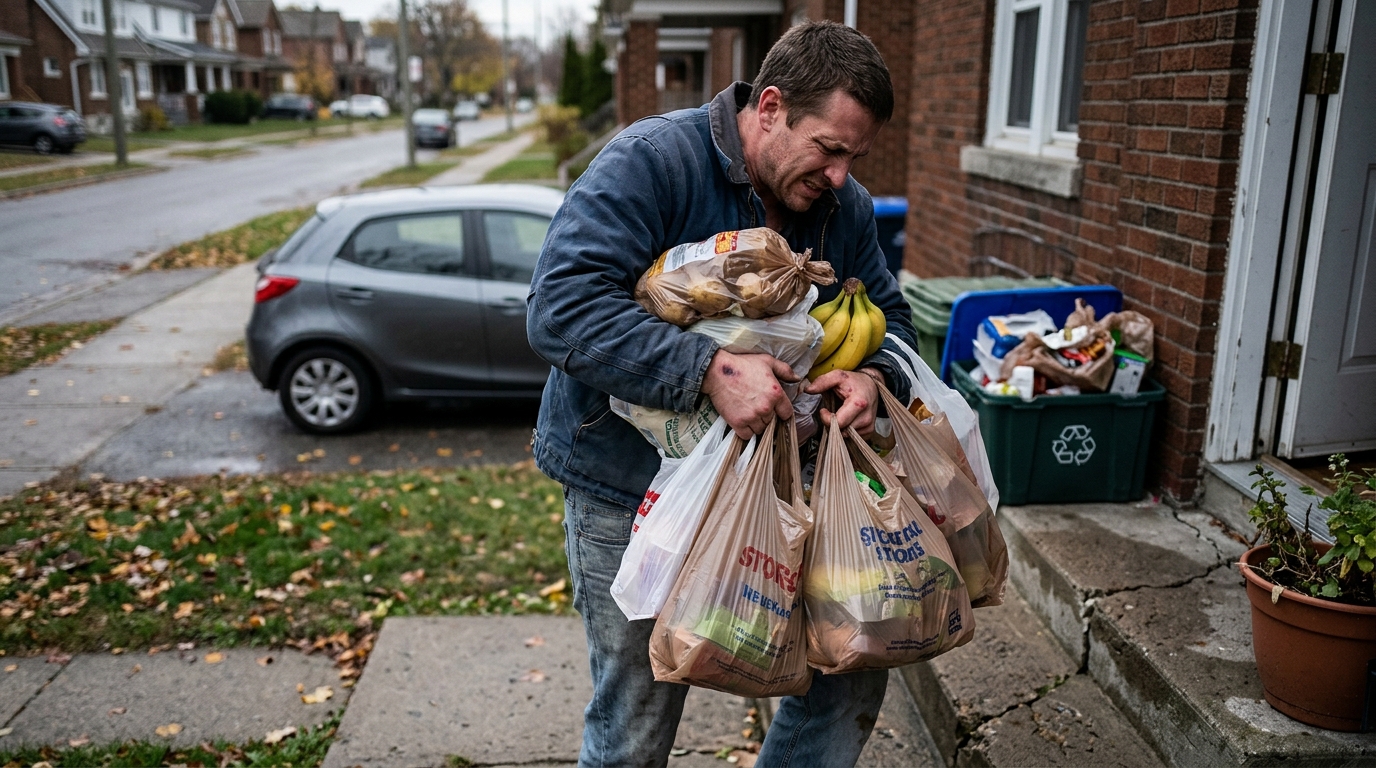
BETHESDA, Md.—Following an eight-year, $14.2 million observational study, researchers at the National Institute of Cognitive Logistics announced Thursday the discovery of a deep-seated human behavioral pattern: individuals will subject themselves to extreme physical discomfort and potential skeletal misalignment to carry all of their grocery bags in a single trip.
The project, which monitored more than 4,500 participants across various simulated residential driveways, concluded that the human brain possesses a profound, almost biological aversion to making a second trip to the car.
"What we have uncovered is a highly coordinated cognitive bias we are designating Unilateral Portal Transit Maximization, or UPTM," said Dr. Aris Thorne, lead author of the study. "When confronted with the choice between two comfortable walks to a vehicle or one agonizing, balance-defying haul wherein plastic handles slowly cut off arterial circulation to the distal phalanges, the human subject will choose the pain of the single trip approximately 94 percent of the time."
To map the exact mechanics of UPTM, researchers outfitted participants with biometric sensors and high-definition cameras as they unloaded a standard midsize sedan. The groceries used in the trials included high-density items such as gallon jugs of whole milk, six-packs of canned seltzers, and heavy jars of marinara sauce.
According to the published data, subjects routinely loaded up to eight plastic bags onto a single hand, using their forearm as a makeshift crane, while simultaneously wedging a package of paper towels under their armpit and gripping a key fob between their teeth.
"The physical toll is staggering," Thorne noted. "We recorded temporary finger elongation of up to four millimeters, acute shoulder subluxation, and significant bruising of the quadriceps from low-hanging soup cans. Yet, when asked why they did not simply leave the seltzer for a second trip, subjects exhibited confusion, with several insisting that doing so would constitute a 'personal failure.'"
Focus group participant Sarah Jenkins, 41, who took part in the longitudinal phase of the study, recalled the intensity of the trials.
"They had us pull up to a fake garage and unload a week’s worth of items," Jenkins said. "I remember my fingers turning entirely white, and I could feel my spine compressing under the weight of the laundry detergent. But I looked at that front door, and I looked at the empty trunk, and I knew that if I went back to that car a second time, the car had won."
The study also examined the control group, which was instructed to make multiple trips with lighter loads. Researchers reported that these participants showed elevated levels of "spatial redundancy shame" and expressed a general sense of inefficiency, despite suffering zero physical injuries.
With the initial phase of the study complete, the Institute is currently lobbying the National Science Foundation for an additional $6.8 million grant to investigate a related behavioral phenomenon: why individuals will aggressively compress a kitchen trash can with their foot to delay changing the liner.