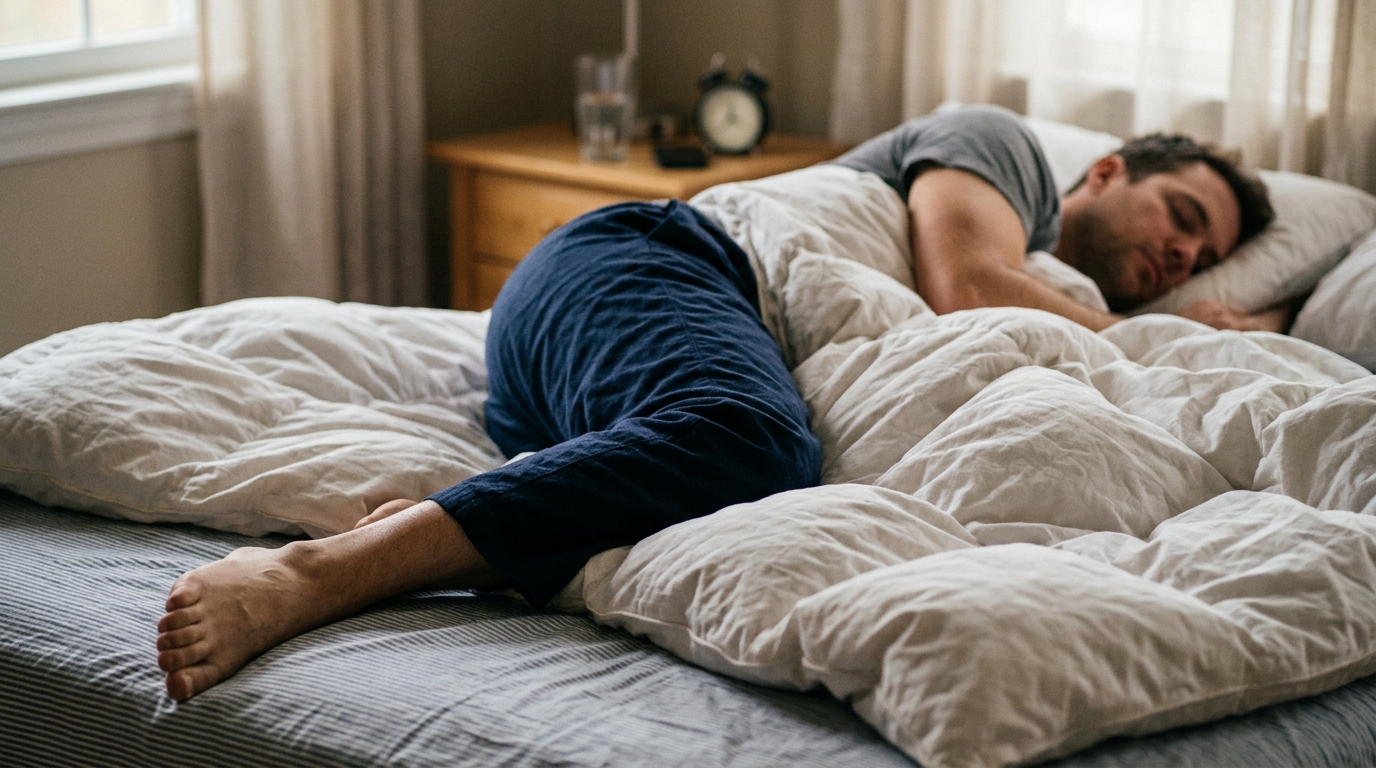
BOSTON — Researchers at the Massachusetts Institute of Somnology announced Thursday that they have successfully mapped the thermodynamic properties of the "one leg out" sleeping posture, confirming that sticking a single lower limb from beneath a comforter is the mathematically optimal method for regulating body temperature during warm summer nights.
The peer-reviewed study, published in the Journal of Nocturnal Thermodynamics, represents the culmination of a five-year, $3.4 million federal research grant. Utilizing high-resolution thermal imaging, polysomnography, and custom-built synthetic beds, researchers monitored 1,200 participants to understand how the human body maintains sleep stability when indoor temperatures hover between 72 and 78 degrees Fahrenheit.
According to the findings, the technique—formally designated as "Unilateral Appendicular Thermal Dissipation" (UATD)—functions as a highly efficient heat-exchange mechanism.
"When an individual is fully covered, they trap a microclimate of warm air, leading to restless REM cycles," said Dr. Aris Thorne, the study's lead author and chair of human biophysics at the institute. "Conversely, removing the blanket entirely triggers a rapid drop in skin temperature, causing mild shivering. However, by exposing exactly one leg—ideally from the mid-calf down to the metatarsals—the body creates a biological radiator. The exposed extremity cools the blood, which then circulates back to the core, maintaining a perfect equilibrium."
The study meticulously cataloged the variables required for maximum efficacy. Researchers noted that the "optimal angle of protrusion" is 45 degrees relative to the mattress edge, and that the exposed foot must remain at least three inches above any carpeted surface to prevent dust-induced micro-awakenings.
While the physiological mechanism has been utilized informally by humans for generations, Dr. Thorne emphasized that scientific validation of the practice was necessary to move sleep science forward.
"Historically, patients complained of being 'too hot but also kind of cold' without any clinical framework to address their distress," Thorne said. "We have now provided that framework. It is no longer a localized habit; it is a peer-reviewed clinical intervention."
Other experts in the field have praised the study for its rigor, noting its immediate practical applications for households without central air conditioning.
"This is a monumental step forward in non-pharmaceutical sleep aids," said Dr. Helen Vance, a sleep-hygiene specialist at Johns Hopkins University who was not involved in the research. "Before this paper, if someone was warm, we could only advise them to turn on a fan. Now, we can write a precise behavioral prescription: left leg out, duvet pulled to the lower rib cage, for a duration of six to eight hours."
Building on the success of the study, the institute announced it has secured an additional $1.8 million from the National Institutes of Health to investigate the molecular structure and thermal lifespan of "the cold side of the pillow."