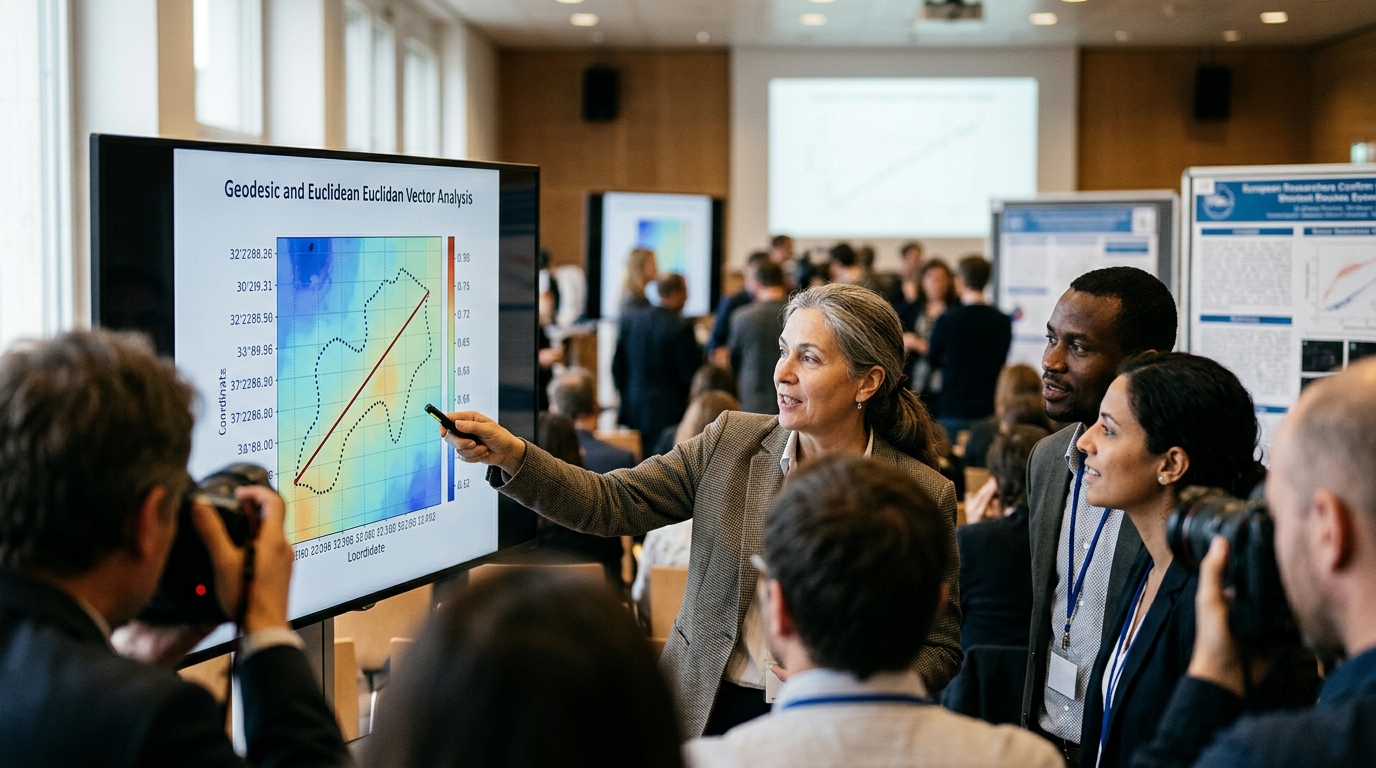
MUNICH — An international coalition of geophysicists and spatial mathematicians has successfully confirmed that the quickest way to reach a destination is to travel directly toward it in a straight line, according to a peer-reviewed study published Sunday in the Journal of Applied Spatial Dynamics.
The five-year, €14.2 million project, funded largely by the European Research Council, utilized high-resolution satellite telemetry, quantum coordinate modeling, and thousands of GPS-tracked pedestrian trials to analyze human transit patterns. Researchers concluded with 99.9% statistical certainty that cutting directly across a public square is faster than walking around its perimeter.
"Until now, the efficiency of the direct route was largely a matter of anecdotal consensus and unproven Euclidean theory," said Dr. Dieter Vogler, director of Munich’s Institute for Linear Optimization. "By deploying advanced spatial vector analysis, we have finally eliminated the guesswork. If you wish to reach Point B from Point A, steering a course that does not curve, loop, or detour is mathematically superior."
The study tracked 12,000 participants navigating various simulated urban environments. Researchers noted that subjects who walked in straight lines consistently arrived at their destinations ahead of those instructed to walk in wide, looping spirals or to pace back and forth.
While some critics within the academic community questioned the allocation of public funds for the study, independent spatial analysts have praised the rigor of the methodology.
"We cannot rely on mere common sense when planning the infrastructure of tomorrow," said Dr. Helen Vance, a transit theorist at the Zurich School of Economics. "Vogler's team has provided the hard, empirical data that municipal planners need to confidently tell pedestrians to just walk straight."
The institute has already secured a secondary €8.7 million grant to investigate whether objects left undisturbed will remain exactly where they were placed.