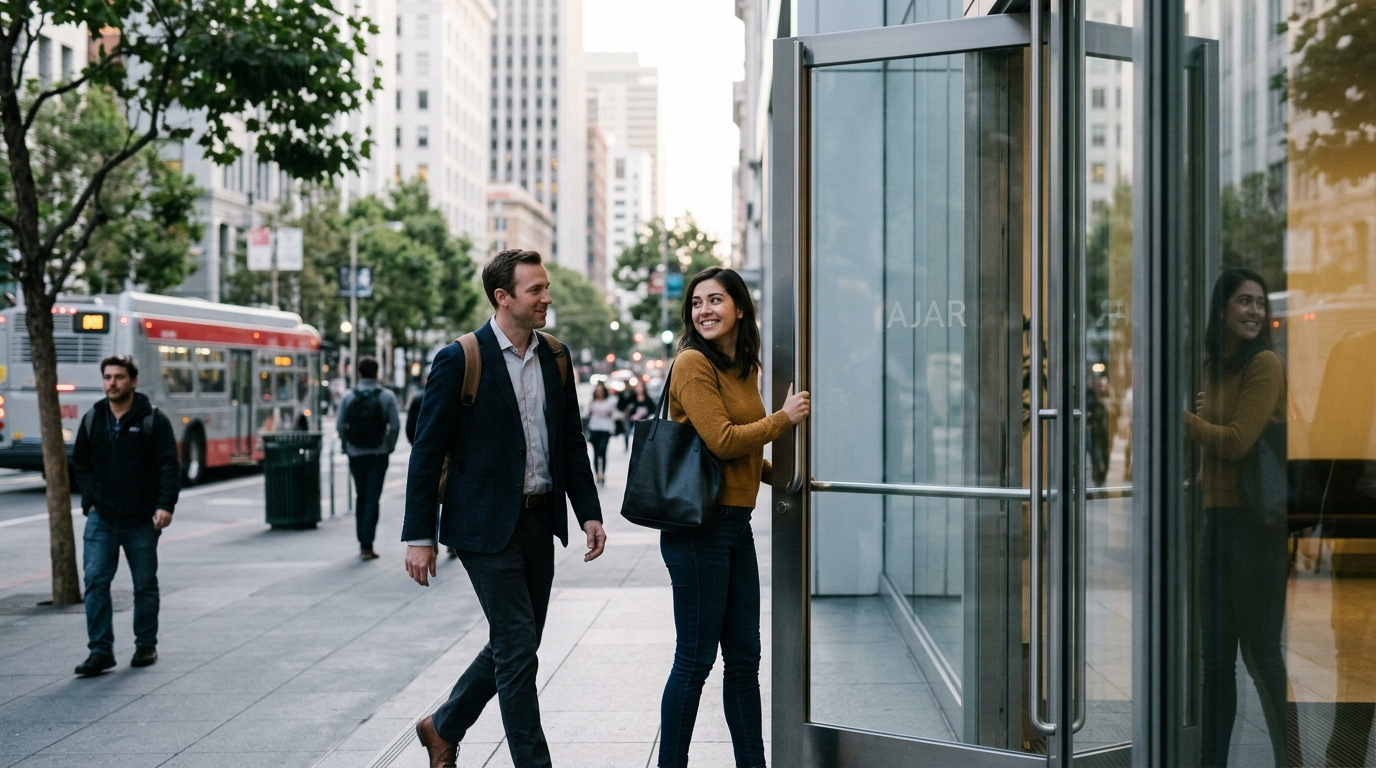
SAN FRANCISCO — San Francisco startup Ajar announced Friday it has secured $14.2 million in Series A funding to digitize the decision-making process of holding doors open for approaching strangers, a physical interaction that has historically relied on unquantified glances and speculative pacing.
The mobile application utilizes low-latency LiDAR and ultra-wideband radar on modern smartphones to scan the area behind a user as they approach a building entryway. If another pedestrian is detected, Ajar instantly calculates their velocity, trajectory, and physical burden—such as heavy grocery bags or hot coffee—to deliver a real-time haptic vibration to the user's wrist. A single pulse means "Release," while a double vibration indicates "Maintain Hold."
"For centuries, humans have operated in a gray zone of non-standardized courtesy," said Devon Hayes, co-founder and chief executive of Ajar. "You see someone 15 feet away. Do you hold the door and force them into an awkward, semi-athletic jog? Or do you let it close and risk looking hostile? Ajar removes the cognitive load of empathy by converting the entire interaction into a clear, binary recommendation."
The app’s free tier, "Standard Courteous," manages basic threshold crossings within a default ten-foot radius. However, the company has seen rapid adoption of its $8-a-month "Premium Passage" subscription. Premium users can broadcast their "hurry status" to other Ajar users up to 30 feet away, pre-negotiating a door release before physical contact is even initiated. A "Pity Hold" feature also allows users to buy back social credit by automatically sending an automated digital apology if they let a door slam on a colleague.
Early adopters report a significant decrease in daily micro-anxieties, though it has required a shift in workplace dynamics.
"Before Ajar, my morning walk into the office was a minefield of eye contact and forced smiles," said Sarah Jenkins, an account executive in Chicago. "Last Tuesday, the app gave me a hard 'Release' vibration when my regional manager was 11 feet away carrying a box of donuts. The app's telemetry showed holding the door would have cost me 4.8 seconds of personal momentum. I let it swing shut. It wasn't personal; it was just the math."
The sudden shift in pedestrian etiquette has introduced new frictions in metropolitan business districts. Pedestrians without the application, colloquially termed "passive entrants" by the company, have complained of an increase in sudden door closures.
Ajar remains undeterred, announcing plans for an autumn software update that will introduce "micro-compensations," allowing users to instantly transfer a $0.15 courtesy tip via Apple Pay to anyone who holds a door open for a distance exceeding 18 feet.