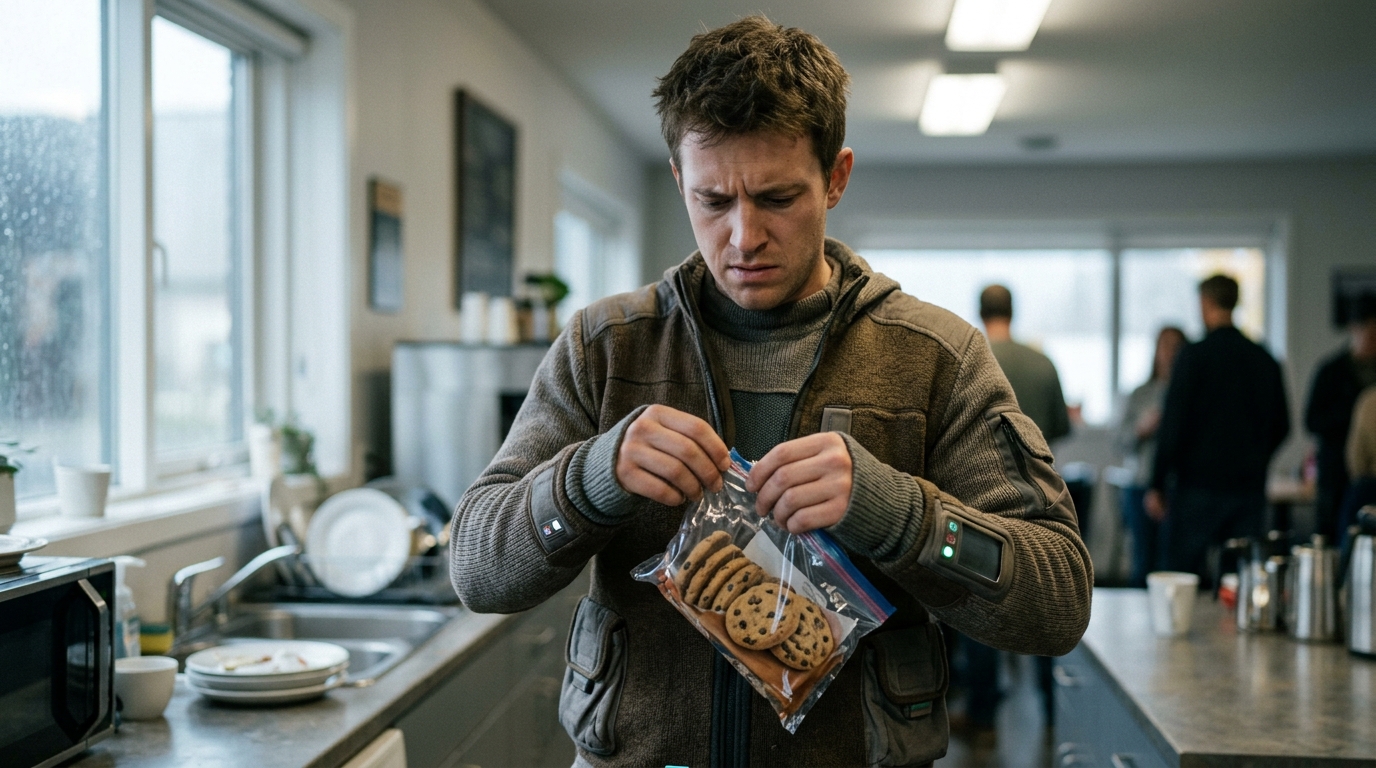
CHICAGO — A temporal traveler who successfully breached the light-speed barrier to visit the year 2026 has expressed profound disappointment that the adhesive "peel-to-reseal" tab on a standard package of sandwich cookies is just as ineffective today as it is in the late 21st century.
Dr. Aris Thorne, a senior chronologist at the New Geneva Institute for Temporal Reconstruction, reportedly materialized in a suburban supermarket on Tuesday morning. Rather than sharing the secrets of cold fusion or warning humanity of impending ecological shifts, Thorne immediately purchased a 14-ounce package of double-stuffed chocolate cookies to test a long-standing historical hypothesis.
"Our historical reconstructions indicated that the early 21st century possessed a highly advanced polymer adhesive capable of maintaining airtight integrity across multiple openings," said Thorne, wearing a specialized pressurized thermal jumpsuit while standing in the cookie aisle. "Instead, upon pulling the designated blue tab, the plastic peeled back unevenly, tore a diagonal strip of the underlying foil, and immediately lost its tackiness due to microscopic cookie crumbs. It is a technological failure of the highest order."
According to witnesses, Thorne spent approximately 45 minutes at the store’s bagging counter attempting to smooth the adhesive strip back over the opening. Despite utilizing a pair of high-precision ceramic tweezers from his utility belt, he was unable to prevent a 3-millimeter gap from exposing the cookies to ambient oxygen.
"He kept repeating that the seal was 'compromised' and asking if we had any vacuum-sealing chambers in the back," said supermarket shift supervisor Marcus Vance. "I offered him a Ziploc bag, but he got very defensive and said that defeated the entire engineering philosophy of the consumer experience. Then he asked to speak to our regional director of packaging compliance."
The mission, which reportedly cost the future institute an estimated 4.2 trillion energy credits and required the stabilization of a localized wormhole, was designed to observe what future historians referred to as the "Era of Perfect Convenience."
Northwestern University physics professor Elena Rostova, who was dispatched by local authorities to communicate with the traveler, confirmed that Thorne refused to share any future technological data until his concerns were addressed.
"We tried to ask him about the trajectory of artificial intelligence and whether humanity colonizes Mars," Rostova said. "But he just kept gesturing to the exposed edge of the package and asking how we could sleep at night knowing our baked goods were subject to rapid staling. He told us that if we couldn't resolve a simple shear-stress adhesive problem, our quantum computing initiatives were built on sand."
Thorne is scheduled to return to the year 2098 on Thursday morning, cutting his historical observation mission short by three weeks. Before preparing his temporal displacement device, he confirmed he would not be visiting the mid-2030s as originally planned.
"If this is the peak of your material science, I have no desire to see what your civilization does with biodegradable milk cartons," Thorne said.