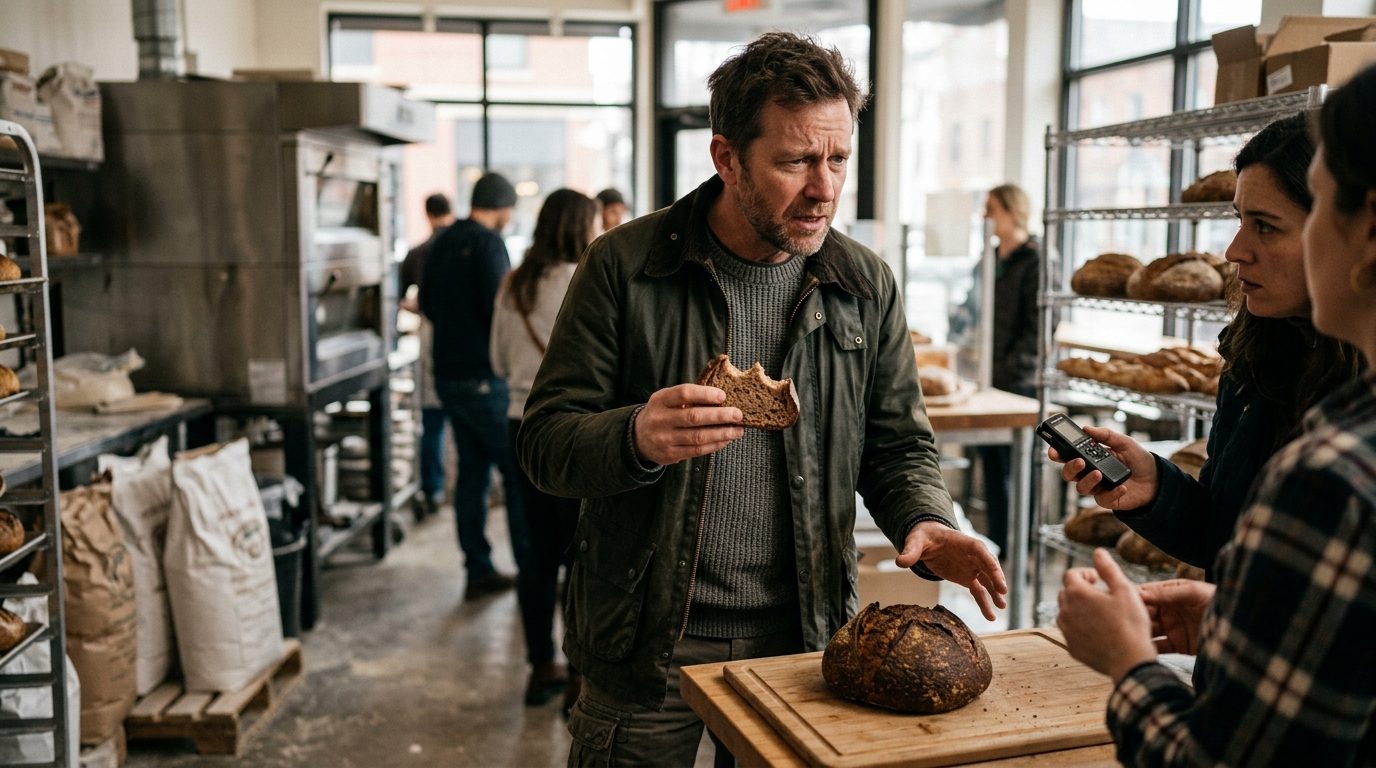
BOSTON — A historic breakthrough in quantum mechanics has ended in premature gridlock after a physicist from the year 2142, who successfully traveled back in time to study the early 21st century, announced he is cutting short his mission due to the underwhelming quality of contemporary artisanal sourdough bread.
Dr. Aris Thorne, 48, materialized in a secure courtyard near the Massachusetts Institute of Technology on Tuesday morning. According to members of the MIT Department of Physics who monitored the localized tachyon emission, Thorne emerged with several notebooks of advanced equations, a dormant atmospheric stabilizer, and an intense craving for what future historians record as the "Golden Age of Wild Fermentation."
However, by Wednesday afternoon, Thorne’s enthusiasm had entirely evaporated outside a highly rated bakery in Boston’s South End.
"The historical archives in the late 22nd century preserve the 2020s as a period of unprecedented domestic baking mastery," Thorne said, gesturing to a half-eaten $16 miche. "We were taught that the pandemic of 2020 catalyzed a global refinement of wild yeast cultures. But this is dense, overly acidic, and the crust has the tensile strength of vulcanized rubber. It is, quite frankly, a structural failure."
Local researchers, who had prepared to ask Thorne about the future of fusion energy and the resolution of the West Antarctic ice sheet crisis, spent most of Wednesday chauffeuring the traveler to various organic bakeries across the metropolitan area in an attempt to salvage the research partnership.
"We tried to steer the conversation toward the grand grand-unified field theory," said Dr. Evelyn Vance, a senior astrophysicist at MIT who assisted with Thorne’s post-arrival debriefing. "But every time we asked about gravity waves, he would just point at his teeth and complain about the crumb structure. He kept asking if we had any 'real' hydration ratios."
According to Thorne, the food supply of the late 22nd century relies heavily on synthesized nutrient gels, which are nutritionally complete but lack sensory complexity. For decades, academic circles in 2142 have romanticized the early 2020s as a culinary paradise of rustic, hand-stretched dough.
Thorne’s disappointment was not limited to bread. After a brief visit to a specialty coffee shop, he described modern cold brew as "essentially battery acid filtered through a woolen sock," and noted that the texture of organic heirloom tomatoes was "entirely too fibrous to justify the labor required to grow them."
Having concluded that the era’s reputation was built on "aesthetic propaganda," Thorne began calibrating his temporal displacement unit late Wednesday night. He plans to return to 2142 on Thursday afternoon, despite warnings from colleagues that a return journey carries a 34 percent risk of molecular degradation.
"My peers told me I would witness the pinnacle of human gastronomy before the great agricultural shifts," Thorne said, packing his instruments. "But if this is the peak, I would rather dissolve into the quantum foam than spend another morning chewing through what is essentially a damp sponge."