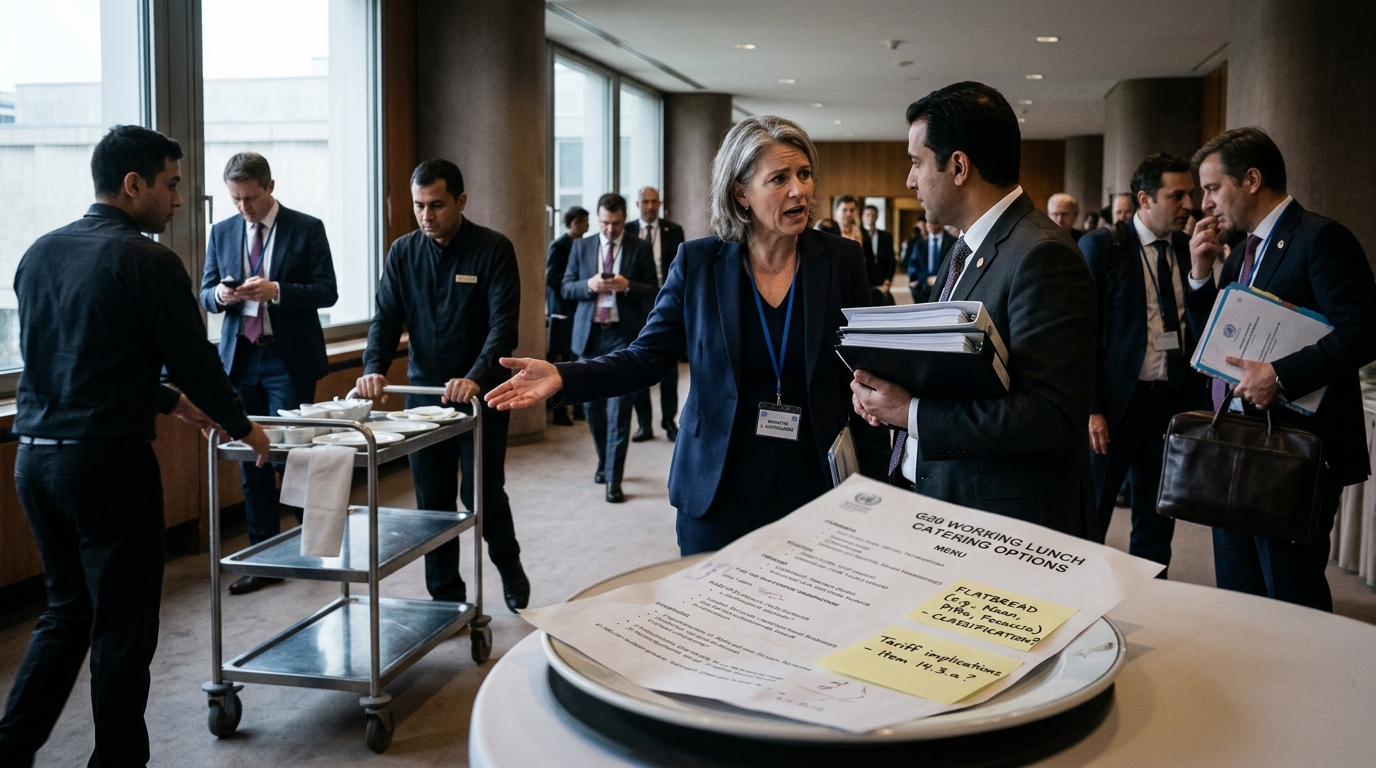
GENEVA — Negotiations for a historic $400 billion global infrastructure pact dissolved in bitterness early Friday morning after G20 delegates spent 72 consecutive hours deadlocked over whether the summit’s catering menu classified an artisanal flatbread as a "wrap" or a "bready vector."
The collapse of the G20 Infrastructure and Logistics Summit, which aimed to modernize deep-water ports across three continents, began on Wednesday during what was intended to be a routine working lunch. According to sources within the drafting committee, the French delegation formally objected to the Swiss caterer's labeling of a grilled, unleavened bread containing goat cheese and arugula as a "wrap," arguing that the nomenclature bypassed strict European Union guidelines on sandwich definitions.
"We are talking about a fundamental question of structural integrity," said Arthur Vance, Deputy Assistant Secretary for Trade Policy at the U.S. Department of Commerce, who participated in the overnight mediation sessions. "The United States delegation was prepared to compromise on port-tariff harmonization, but we cannot sign a joint communiqué that implicitly legitimizes the term 'bready vector' for what is clearly a folded flour-tortilla analog. It sets a dangerous precedent for agricultural imports."
By Thursday evening, the core work of the summit—including a major clean-energy transit corridor through Central Asia—had been entirely suspended. The main plenary hall was converted into a temporary arbitration tribunal, where trade attorneys from 14 nations analyzed the tensile strength and fold angle of the disputed flatbreads.
The dispute deepened when the Mexican delegation issued a formal reservation, stating that if the flatbread was classified as a tortilla analog, it must be subject to the rules of origin defined in the United States-Mexico-Canada Agreement (USMCA). This prompted a retaliatory veto from the Canadian delegation, which refused to authorize the maritime shipping accord unless the catering staff also provided hot maple-glazed pastries during the afternoon coffee break.
"The language of the buffet is the language of the treaty," explained Dr. Elena Rostova, a Swiss international trade arbitrator brought in to mediate the dispute at 3:00 a.m. on Friday. "If a state yields on the classification of starch-based carriers at the luncheon level, it compromises its bargaining leverage on heavy machinery tariffs in the afternoon. The delegates understood the stakes."
At 6:15 a.m., the Japanese delegation announced its departure, citing a "complete breakdown of administrative logic." Within two hours, the remaining delegations had packed their briefcases, leaving the draft infrastructure treaty unsigned.
While the failure of the summit is expected to delay several major harbor expansions by at least two years, organizers defended the priority placed on the catering dispute.
"We must have order in all things," said Pierre-André Lazard, chief logistics officer for the Geneva International Conference Center. "If we cannot agree on what constitutes a sandwich in a controlled environment, we have no business coordinating the global flow of liquefied natural gas."
Following the formal cancellation of the summit, members of the German and British delegations were seen sharing a cab to a nearby airport terminal, where they reportedly ordered several boxes of standardized McNuggets without further diplomatic incident.