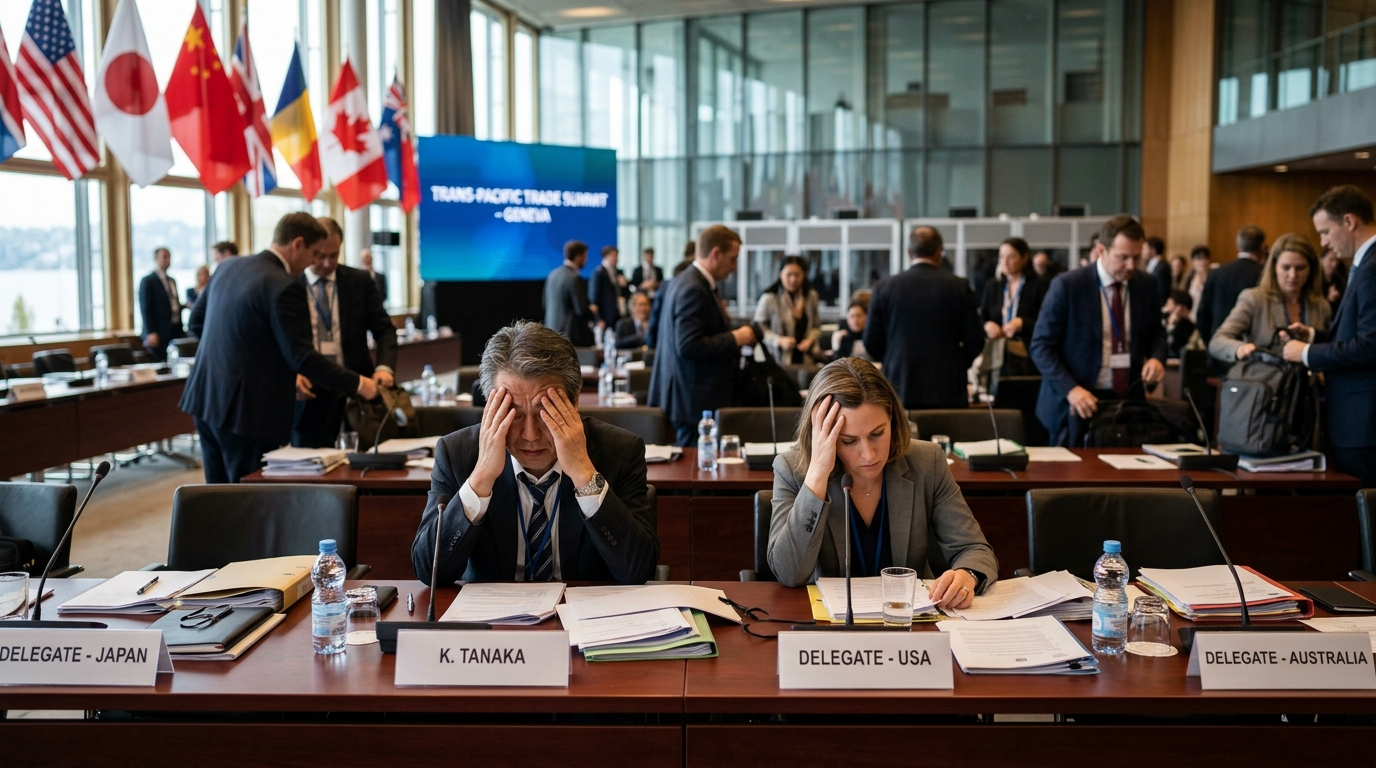
GENEVA — A landmark multilateral trade agreement designed to streamline global shipping lanes collapsed on Thursday morning after international delegates failed to reach a consensus on the catering menu for the summit’s working lunches.
The collapse of the Trans-Pacific Maritime and Logistics Accord, which had been four years in the active drafting phase, occurred during the finalization of the "Sub-Annex on Shared Dietary Infrastructure." According to sources inside the Palais des Nations, the talks broke down permanently over whether the Yukon Gold potato constituted a "nationally neutral starch" or an "uncompensated domestic subsidy."
The dispute began on Monday during what was expected to be a routine approval of the summit’s lunch buffet. The North American delegation had proposed a roasted root vegetable medley as a side dish for the three-day event. However, representatives from the East Asian Trade Coalition formally objected, arguing that the inclusion of the potato violated Paragraph 4.2 of the 2018 San Francisco Convention on Culinary Equivalence, which prohibits the consumption of "geopolitically loaded carbohydrates" during active arbitration.
"We offered several concessions, including a 15 percent reduction in maritime transit tariffs, in exchange for a rosemary-infused fingerling potato," said Marcus Vance, chief negotiator for the North American delegation. "But the other side refused to move off their position on steamed white rice. We cannot, in good faith to our domestic growers, sign a treaty under the shadow of a single-carb regime."
The impasse triggered a cascade of bureaucratic retaliations. By Tuesday afternoon, the European delegation had introduced a 42-page amendment demanding the immediate disqualification of all nightshade-family plants from the buffet, citing "precautionary digestive protection." In response, the South American bloc threatened to veto the entire maritime cargo quota if the salad bar did not feature a legally binding vinaigrette ratio.
"This was not merely about sustenance; it was about administrative parity," explained Dr. Elena Rostova, a special envoy for agricultural standards who observed the talks. "Once you concede the starch, you concede the narrative. If one side is digesting a complex carbohydrate while the other is operating on a simple glucose curve, the intellectual playing field is no longer level."
By Wednesday night, professional mediation teams from the World Trade Organization were brought in to draft a compromise menu featuring quinoa, but the grain was rejected by three separate subcommittees who classified it as an "unregistered pseudocereal" capable of granting an unfair cognitive advantage.
The final session ended at 4:13 a.m. when Geneva hospitality staff, citing local labor laws regarding overnight hot-holding cabinets, removed the chaffing dishes from the conference hall, effectively terminating the treaty. At press time, global shipping stocks had fallen 4.2 percent, while the leftover roasted potatoes were quietly composted behind the Swiss federal building.